
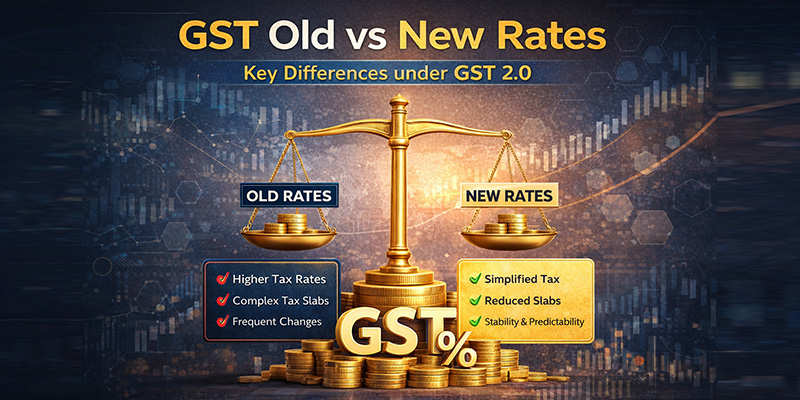
When the Goods and Services Tax (GST) was implemented in 2017, it replaced a complicated network of central and state levies with a unified indirect tax system. While this reform was transformative, over time, the system became burdened with multiple slabs, inverted duty structures, and procedural delays, leading to inefficiencies for both businesses and consumers.
To address these gaps, the government rolled out GST 2.0 on 22 September 2025. The revised framework simplifies tax rates, reduces anomalies, and streamlines compliance. This article compares the earlier GST rate structure with the new GST 2.0 framework, and highlights how these changes are expected to reduce costs, improve business ease, and accelerate economic growth.
Old GST Rate Structure (Before September 2025)
The original GST framework consisted of four key slabs, along with exemptions and a cess on luxury and sin goods:
- 0% – Essential goods and services (e.g., fresh food, basic healthcare, and education).
- 5% – Select household essentials and services.
- 12% – Processed food, certain appliances, and some services.
- 18% – The standard rate applied to most goods and services.
- 28% – Luxury and sin goods such as automobiles, cement, air conditioners, and tobacco (often with additional cess).
Key Challenges in the Old Regime
- Complexity of Multiple Slabs created confusion and compliance challenges.
- Inverted Duty Structures, where inputs were taxed higher than finished goods, led to refund delays and cash flow issues.
- High Tax on Essentials like cement, insurance, and healthcare increased consumer costs.
- Administrative Bottlenecks slowed registration, refunds, and dispute resolution.
New GST 2.0 Rate Structure (From September 2025)
GST 2.0 addresses these shortcomings by introducing a more streamlined and balanced structure with fewer slabs:
- 0% GST – Essentials and insurance premiums.
- 5% GST – Commonly used goods and agricultural inputs.
- 18% GST – The standard rate for most goods and services.
- 40% GST – Sin and luxury goods.
Comparative Analysis: Old vs New GST Rates
|
Category / Goods & Services |
Old GST Rate |
New GST 2.0 Rate |
Impact |
|
Essentials (milk, bread, chapati, life-saving drugs) |
0% |
0% |
No change; remains exempt. |
|
Health & Life Insurance Premiums |
18% |
0% |
Major relief; lowers household costs. |
|
Educational Supplies (pencils, maps, erasers) |
12% |
0% |
Reduces cost of education. |
|
Dairy Products (butter, ghee, biscuits, juices) |
12% |
5% |
Significant consumer savings. |
|
Personal Care (soap, shampoo, toothpaste) |
18% |
5% |
Daily essentials become more affordable. |
|
Agricultural Machinery (tractors, harvesters) |
12% |
5% |
Reduced input cost for farmers. |
|
Electronics (TVs up to 32 inches, ACs, dishwashers) |
28% |
18% |
Lower household expenditure. |
|
Cement |
28% |
18% |
Relief for real estate and infrastructure. |
|
Automobiles (motorcycles up to 350cc, commercial vehicles) |
28% |
18% |
Encourages demand in the auto sector. |
|
Hotel Rooms up to ₹7,500/night |
28% |
18% |
Makes tourism and hospitality more affordable. |
|
Luxury Cars, Imported Goods, Premium Jewellery |
28% + cess |
40% |
Higher cost of luxury consumption. |
|
Tobacco, Alcohol & Sin Goods |
28% + cess |
40% |
Stronger deterrent with higher taxation. |
Key Takeaways
- Simplified Structure: Reduced from four main slabs to two (5% and 18%), with exemptions and a high slab for luxury items.
- Relief for Households: Lower tax on food items, healthcare, insurance, and personal care reduces day-to-day expenses.
- Boost for Key Industries: Real estate, agriculture, automobiles, and consumer goods benefit from lower rates.
- Balanced Taxation: Essentials made cheaper while luxury and sin goods face higher levies, ensuring social equity.
- Easier Compliance: Fewer slabs mean less complexity and smoother compliance for businesses.
Conclusion
GST 2.0 is a significant reform aimed at addressing the shortcomings of the earlier regime. By simplifying slabs, rationalising rates, and introducing pro-consumer measures, the new structure provides relief to households, reduces compliance challenges for businesses, and encourages investment in key sectors. For the economy, GST 2.0 represents a shift toward a more efficient, equitable, and growth-oriented tax system.
If you have any further questions or need assistance, feel free to reach out to us at admin@ushmaassociates.com or info@nricaservices.com, or contact us via call/WhatsApp at +91 9910075924.
Stay Updated, Stay Compliant!
Disclaimer: Aim of this article is to give basic knowledge about the topic to people who are not in touch with Indian tax norms. When anybody is dealing with these kinds of cases practically, he shall consider all relevant provisions of all applicable Laws like FEMA/Income Tax/RBI /Companies Act etc.