
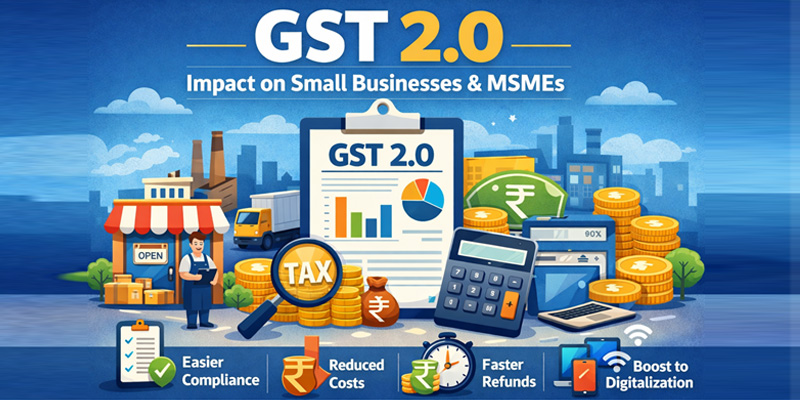
The introduction of GST 2.0 in September 2025 marks a significant step forward in India’s indirect tax landscape. While the original GST framework launched in 2017 unified the tax system, it also brought with it multiple tax slabs, inverted duty structures, and a heavy compliance burden that proved particularly challenging for small businesses and MSMEs. GST 2.0 has been introduced to address these concerns, focusing on simplified compliance, rationalized tax rates, and enhanced ease of doing business.
This article explores the key implications of GST 2.0 for small businesses and MSMEs.
- Simplified Tax Structure
- Fewer Tax Slabs: By merging multiple slabs, GST 2.0 has reduced the complexity of rate classifications. This makes pricing and invoicing more straightforward for MSMEs.
- Lower Rates on Essentials: Essential goods and services used by small enterprises—such as raw materials, tools, and digital solutions—now fall under reduced tax brackets.
Impact: Eases working capital pressures and ensures smoother compliance for small manufacturers and traders.
- Easier Compliance Framework
- Annual Return for Small Taxpayers: Entities with turnover up to a prescribed limit (likely ₹2 crore) now need to file only one annual return, instead of multiple monthly filings.
- Automated Reconciliation: The GSTN portal auto-populates input tax credits and matches invoices, reducing manual intervention.
- Consolidated Registration: MSMEs with operations across states can now opt for a single GST registration, avoiding the hassle of multiple state-wise registrations.
Impact: Reduced administrative effort, lower compliance costs, and fewer professional dependencies.
- Input Tax Credit (ITC) Reforms
- Real-Time ITC: Credits are now available immediately once suppliers upload invoices.
- Expanded Eligibility: Several previously restricted credits—such as certain utilities and business essentials—are now admissible.
Impact: Strengthens cash flow and minimizes cascading of taxes.
- Higher Thresholds & Improved Composition Scheme
- Enhanced Registration Threshold: The exemption limit for mandatory registration has been raised (expected ₹60 lakh for goods and ₹40 lakh for services).
- Simplified Composition Scheme: Eligible MSMEs can pay tax at a lower flat rate with quarterly filings and minimal record-keeping requirements.
Impact: Enables micro and small enterprises to remain compliant without excessive regulatory burdens.
- Emphasis on Digitalization
- Simplified E-Invoicing: MSMEs below a higher turnover limit (likely ₹5 crore) are exempt from mandatory e-invoicing.
- Dedicated GST App: A mobile-based application now supports filing, ITC claims, and payment tracking, improving accessibility.
Impact: Empowers small business owners to manage compliance independently with minimal technical complexity.
- Transition Challenges for MSMEs
Despite significant relief measures, some challenges remain:
- Upgrading accounting systems to align with GSTN 2.0 requirements.
- Understanding revised HSN codes and compliance rules.
- Managing the migration of unutilized credits into the new system.
- The Road Ahead
GST 2.0 is expected to:
- Enhance liquidity by accelerating ITC availability.
- Lower the compliance burden through simplified processes.
- Encourage more MSMEs to integrate into the formal economy.
That said, widespread awareness, capacity-building initiatives, and timely professional guidance will be crucial to ensure a smooth transition for small businesses.
Conclusion
GST 2.0 has been designed with MSMEs at the heart of reform. By reducing compliance complexities, easing cash flow, and encouraging digital adoption, it holds the potential to transform the operating environment for small enterprises. If implemented effectively, it will not only ease day-to-day compliance but also strengthen the competitiveness of MSMEs in both domestic and global markets.
If you have any further questions or need assistance, feel free to reach out to us at admin@ushmaassociates.com or info@nricaservices.com, or contact us via call/WhatsApp at +91 9910075924.
Stay Updated, Stay Compliant!
Disclaimer: Aim of this article is to give basic knowledge about the topic to people who are not in touch with Indian tax norms. When anybody is dealing with these kinds of cases practically, he shall consider all relevant provisions of all applicable Laws like FEMA/Income Tax/RBI /Companies Act etc.